Understanding the BRCA Gene
What are BRCA genes?
BRCA stands for Breast Cancer gene. The two main genes are BRCA1 and BRCA2. Everyone inherits these genes from their parents, and their normal role is to help protect the body from cancer.
What do BRCA genes do?
BRCA1 and BRCA2 are tumour suppressor genes. They repair damaged DNA, help cells grow normally, and prevent damaged cells from becoming cancerous.
What happens if there is a BRCA mutation?
Some people inherit a harmful mutation (also called a pathogenic variant) in one of these genes. This reduces the gene's ability to repair DNA, allowing damage to build up over time. This increases the lifetime risk of several cancers, including breast, ovarian, prostate, pancreatic and male breast cancer.

Having a BRCA mutation does not mean someone will definitely develop cancer—it means their risk is significantly higher than average.
How common are BRCA mutations?
Around 1 in 400–500 people in the general population carry a harmful BRCA1 or BRCA2 mutation. Some groups, such as people of Ashkenazi Jewish ancestry, have a higher rate (around 1 in 40).
Who should consider testing?
Genetic testing may be recommended for people with a strong family history of breast, ovarian, prostate or pancreatic cancer, breast cancer at a young age, male breast cancer in the family, or a known BRCA mutation in a close relative.
Summary
BRCA1 and BRCA2 are genes that help repair DNA and protect against cancer. A harmful inherited mutation increases the risk of several cancers but does not mean cancer is inevitable. Many people with BRCA mutations never develop cancer, especially with appropriate screening, lifestyle measures and, where appropriate, risk-reducing treatments.
Why I Chose Genetic Testing – My BRCA Journey
My sister Bernadette, passed away from breast cancer in 1988, she was just 34. It was extremely traumatic for the whole family. It scared the shit out of us all. She was the first in our immediate family, although all my father's sisters passed with breast or ovarian cancer, we were unaware there was a connection. We held Bernadette as she took her last breath, softly singing to her her favourite song.
When she was having her treatment, she was told by her doctor that research was underway to determine if breast cancer is hereditary, and in the future, there may be a test for her daughter to take, which will show if she was at risk of developing breast cancer. We didn't believe that would happen but of course it did.
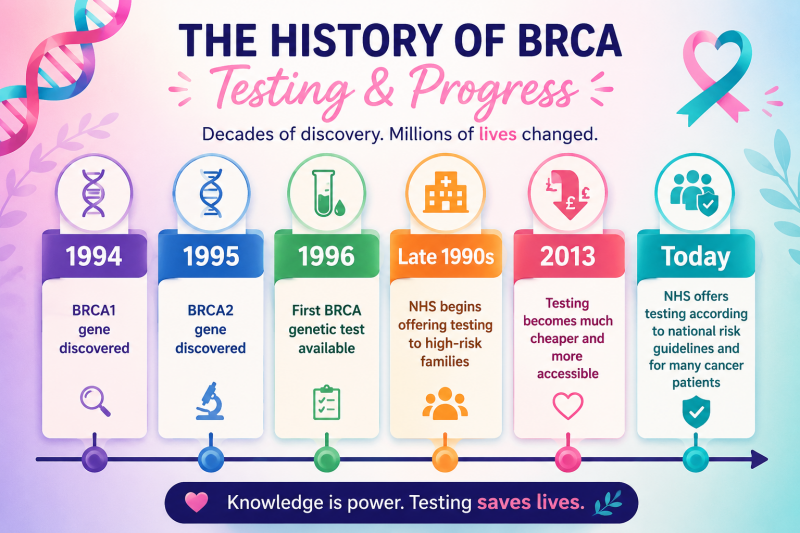
A few years after Bernadette's passing, I decided to explore the relatively new field of genetic testing. At the time, BRCA testing was still in its early years and was far less accessible than it is today. I contacted the Regional Genetics Centre in Leeds myself to ask whether I could be assessed.
I was offered a consultation, but my two remaining sisters had no interest in being tested. During my appointment, the genetic counsellor explained that they were unable to confirm whether I carried the faulty gene without first identifying it in a blood sample from Bernadette. Sadly, that was no longer possible. It would be like finding a needle in a haystack - This is because they were looking for the specific mutation causing cancer in my family. Without an affected relative's blood or tissue sample, they had to search through the entire BRCA1 and BRCA2 genes, which are very large. At the time, this was slow, expensive, and much less reliable. Whereas now, a blood or saliva sample from a deceased relative is no longer usually essential.
In my consultation, because of the significant history of breast cancer on my father's side of the family, they believed there was around a 98% probability that I was at very high inherited risk. They were sufficiently concerned to recommend that my GP consider referring me for a preventative double mastectomy.
I remember sitting there in complete disbelief. I was convinced they were overreacting. After all, I was healthy, and surely something so drastic couldn't possibly be necessary.
So I walked away.
Looking back now, that decision would become one of the biggest mistakes of my life.
What many people don't realise is that the discovery of BRCA genetic testing has saved countless lives. It has enabled families to understand their inherited cancer risk and, in many cases, take preventative action before cancer has the chance to develop.
- Now the laboratories can sequence the entire BRCA1 and BRCA2 genes quickly and accurately from your own sample.
- They can also test many other inherited cancer genes at the same time using a multi-gene panel, something that wasn't possible in the 1990s.
- Results are usually available within a few weeks rather than many months.
- Testing an affected family member first is still considered the ideal approach because:
- If a mutation is found in that person, testing other relatives becomes much simpler and gives a clearer answer.
However, if that isn't possible, as was in my case, genetics services can often still provide meaningful testing based on your own DNA and your family history.

How Do Doctors Test for the BRCA Gene?
Everyone has BRCA1 and BRCA2 genes. Genetic testing does not look for whether you have these genes—it looks for whether you have a harmful mutation (change) in one of them.
1. Genetic counselling
Before testing, a genetics specialist or genetic counsellor will usually discuss your personal and family history of cancer, explain the test and what the results may mean for you and your relatives.
2. Blood or saliva sample
A small blood sample or saliva sample is collected. This is all that is needed for the laboratory to analyse your DNA.
3. DNA extraction
Scientists extract DNA from the sample. Every cell contains DNA, providing enough genetic material for testing.
4. Analysing the BRCA genes
The laboratory examines the BRCA1 and BRCA2 genes and compares them with the normal gene sequence to identify any harmful mutations.
5. Understanding the results
Results usually fall into one of three categories:
• No mutation found – no harmful BRCA mutation was detected.
• Harmful mutation found – an inherited mutation that increases the risk of certain cancers was identified. It does not mean you currently have cancer or will definitely develop it.
• Variant of Uncertain Significance (VUS) – a genetic change was found, but it is not yet known whether it increases cancer risk.
If a BRCA mutation is found
Your healthcare team may recommend more frequent screening, MRI scans, preventive medication, risk-reducing surgery for some people, and genetic testing for close relatives, who each have a 50% chance of inheriting the same mutation.
Key Message
The BRCA test itself is simple and usually involves only a blood or saliva sample. The valuable part of the test is the information it provides, helping people understand their cancer risk and make informed decisions about screening, treatment and prevention.
If you found this information useful and would like to be notified of future posts 📩 please leave your information via contact the button below (Please read my Privacy Policy as the safety of your details are important to me) or if you would like to make a comment / ask a question, please submit your comment or question below - Thank you for taking the time to read this 🌸
Add comment
Comments