One of the phrases many people hear shortly after a cancer diagnosis is:
"Your case will be discussed at the MDT."
For many patients, this can feel confusing, frustrating and sometimes even worrying. Questions naturally arise:
What is an MDT?
Why do I need one?
Will it delay my treatment?
Can anything happen before the meeting takes place?
As someone who has experienced cancer personally and spent many years supporting people through difficult health challenges, I wanted to explain what MDTs are, why they exist and how you can feel more informed while navigating the process.
Having worked in the pharmaceutical industry for over 20 years, I am familiar with MDTs and the important role they play in patient care. Virtually every therapy area has its own multidisciplinary team, bringing together specialists to discuss cases, share expertise and agree the best treatment pathway for each patient
What Does MDT Mean?
MDT stands for Multidisciplinary Team.
It is a meeting where healthcare professionals from different specialities come together to discuss a patient's diagnosis and agree on the most appropriate treatment plan.
Depending on the type of cancer, the team may include:
• Surgeons
• Oncologists
• Radiologists

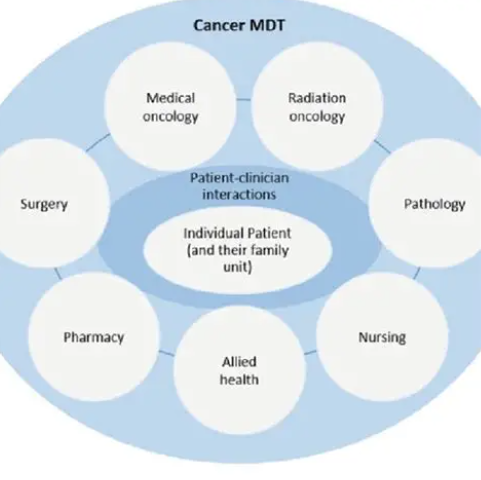
• Pathologists
• Specialist nurses
• Other healthcare professionals involved in your care
The purpose is simple: to ensure that treatment decisions are based on the combined expertise of several specialists rather than just one opinion.
Why MDTs Are Important
Cancer care has become increasingly specialised.
A surgeon may have expertise in operating.
A radiologist may be best placed to interpret scans.
An oncologist may advise on chemotherapy, immunotherapy or radiotherapy.
By bringing these specialists together, MDTs help ensure that every aspect of a patient's case is considered.
In principle, MDTs are an essential part of high-quality cancer care because they help reduce variation in treatment recommendations and ensure patients receive the most appropriate options available.
When MDTs Work Well
In many cases, MDT meetings provide valuable reassurance.
Complex cases often benefit enormously from discussion between specialists.
They can help identify treatment options that one clinician alone may not have considered and ensure everyone involved in your care is working from the same information.
For patients, this means treatment plans are usually more robust and carefully considered.
Why Some Patients Become Frustrated
One of the most difficult parts of a cancer diagnosis is waiting.
When you have been told you may have cancer, every day can feel like a week.
Sometimes patients are informed that nothing can happen until the MDT meeting takes place.
This can create the impression that treatment is being delayed.
In reality, some decisions genuinely do require MDT discussion.
However, there are occasions when certain investigations, referrals or practical steps could potentially begin before the meeting takes place.
This is where asking questions can be helpful.
A Question Worth Asking
One useful question to ask your healthcare team is:
"Is there anything that can happen before my MDT meeting, including referrals or investigations, so that we are not losing valuable time?"
This is not about being demanding. It is about understanding the process and ensuring that any appropriate next steps are already moving forward.
Sometimes the answer may be no.
Other times there may be practical actions that can begin immediately.
Understanding Delays
It is important to remember that waiting does not necessarily mean nothing is happening.
Results may still be coming back from pathology.
Additional scans may be required.
Specialists may need further information before making recommendations.
However, there can be situations where delays occur simply because a decision is waiting for the next scheduled meeting.
This is why open communication with your healthcare team is so important.
If you are unsure why you are waiting, ask.
Most healthcare professionals will be happy to explain the reason.
You Are Not Being Difficult
Many people worry about asking questions because they do not want to appear pushy or demanding.
Please don't let that stop you.
Asking questions is not complaining.
Asking questions is not challenging your medical team.
Asking questions is part of being informed and involved in your own care.
Your healthcare team wants you to understand what is happening and why.
Practical Tips While Waiting for an MDT
• Write down any questions as they come into your mind.
• Take somebody with you to appointments where possible.
• Ask who your specialist nurse is and how to contact them.
• Find out when your MDT meeting is expected to take place.
• Ask when you should expect to hear the outcome.
• Clarify whether any additional tests or referrals can happen beforehand.
Having answers to these questions can help reduce anxiety and give you a greater sense of control.
A Personal Reflection
One thing cancer taught me is that uncertainty can often feel harder than the treatment itself.
Waiting for results, waiting for appointments and waiting for decisions can leave you feeling powerless.
Knowledge does not remove fear completely, but it does make the journey easier to navigate.
Understanding what an MDT is and why it exists can help transform it from a mysterious acronym into something much more reassuring.
The MDT is there to help ensure you receive the best possible care.
And while waiting can be difficult, never be afraid to ask questions, seek clarification and become an active participant in your own healthcare journey.
With love and hope, 💗
Jane Kellett
Psychotherapist | Breast Cancer Survivor | Founder of Mission Self Reset
Add comment
Comments